













 +8615919897308
  info@nfctagfactory.com
 A comprehensive guide to understanding RFID smart card technology, its applications, and benefits in today's digital world.
What is an RFID Smart Card?
An RFID smart card, short for Radio Frequency Identification smart card, is a portable device that integrates RFID technology with a micro-integrated circuit (IC) chip. Its key characteristic is the ability to communicate data with contactless readers via radio waves, eliminating the need for physical contact or visible optical scanning.
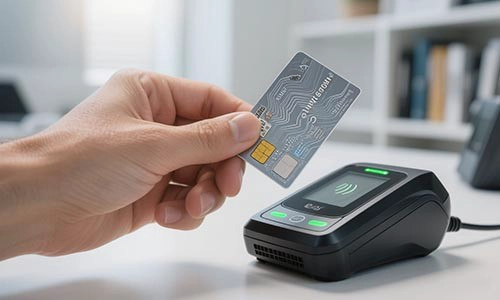
Compared to traditional magnetic stripe cards or contact IC cards, the core components of an RFID smart card include:
- Integrated Circuit Chip: Serves as the "brain" of the card, responsible for data storage, processing, and executing security encryption algorithms.
- Antenna: Used to receive radio frequency signals from the reader, power the chip, and enable data transmission.
- Card Body: Typically made of durable materials like PVC, providing protection for the internal components.
Technical Principles: How Does Contactless Communication Work?
The operation of RFID smart cards is based on electromagnetic induction, representing an efficient, rapid automated process:
- Power Acquisition and Activation: When the card enters the electromagnetic field generated by the reader, the card's antenna captures RF energy and converts it into electrical power to activate the chip.
- Command and Response: The reader sends query commands to the activated card. The card's chip processes these commands and transmits specific data from its memory back to the reader.
- Data Verification and Execution: The reader receives and decodes the signal, then forwards the information to backend systems to trigger corresponding actions.
This entire process typically completes within milliseconds, ensuring high efficiency and excellent user experience.
Main Types and Classifications
Based on operating frequency, security level, and functionality, RFID smart cards are primarily categorized as follows:
By Frequency
- Low Frequency Cards: Typically 125kHz. Advantages include strong penetration capability, but with short read range and low data rate.
- High Frequency Cards: Typically 13.56MHz. This is the most widely used type, offering a good balance between read range, data rate, and security.
- Ultra High Frequency Cards: Operating at 860-960MHz. These offer longer read ranges but are more susceptible to signal interference.
By Security and Functionality
- Memory Cards: Only capable of data storage with low security.
- Logical Encryption Cards: Feature added password protection mechanisms with enhanced security.
- CPU Cards: Contain microprocessor operating systems capable of complex encryption operations, offering the highest security level.
Key Advantages: Why Choose RFID Smart Cards?
The widespread adoption of RFID smart cards stems from their multiple outstanding advantages:
- Convenient Operation: Contactless reading and writing significantly improve access and payment speed.
- High Security: Data stored in chips is difficult to copy or forge, with dynamic encryption providing robust protection.
- Durability and Reliability: No exposed contacts, resistant to environmental factors and physical wear.
- Multi-function Capability: Single cards can integrate multiple applications like access control and payment systems.
- High Processing Efficiency: Capable of reading multiple cards simultaneously, ideal for high-traffic environments.
Application Scenarios
RFID smart cards have penetrated various industries:
- Access Control and Time Attendance: Provide secure, controllable physical access control for enterprises.
- Payment and Transportation: Powers "tap-to-pay" bank cards and public transportation systems.
- Identity Verification: Used in electronic passports and corporate ID cards storing biometric data.
- Asset Management: Track and manage important corporate assets.
- Membership and Marketing: Serve as identity credentials for customer relationship management.
Conclusion
In summary, an RFID smart card is much more than a piece of plastic - it's a powerful, secure, and versatile information carrier. Its contactless operation principle delivers unparalleled convenience and reliability, making it a key technology driving society toward greater efficiency and security. As it continues to integrate with NFC and biometric technologies, RFID smart cards will maintain their central role in IoT and smart city development, with unlimited future potential.